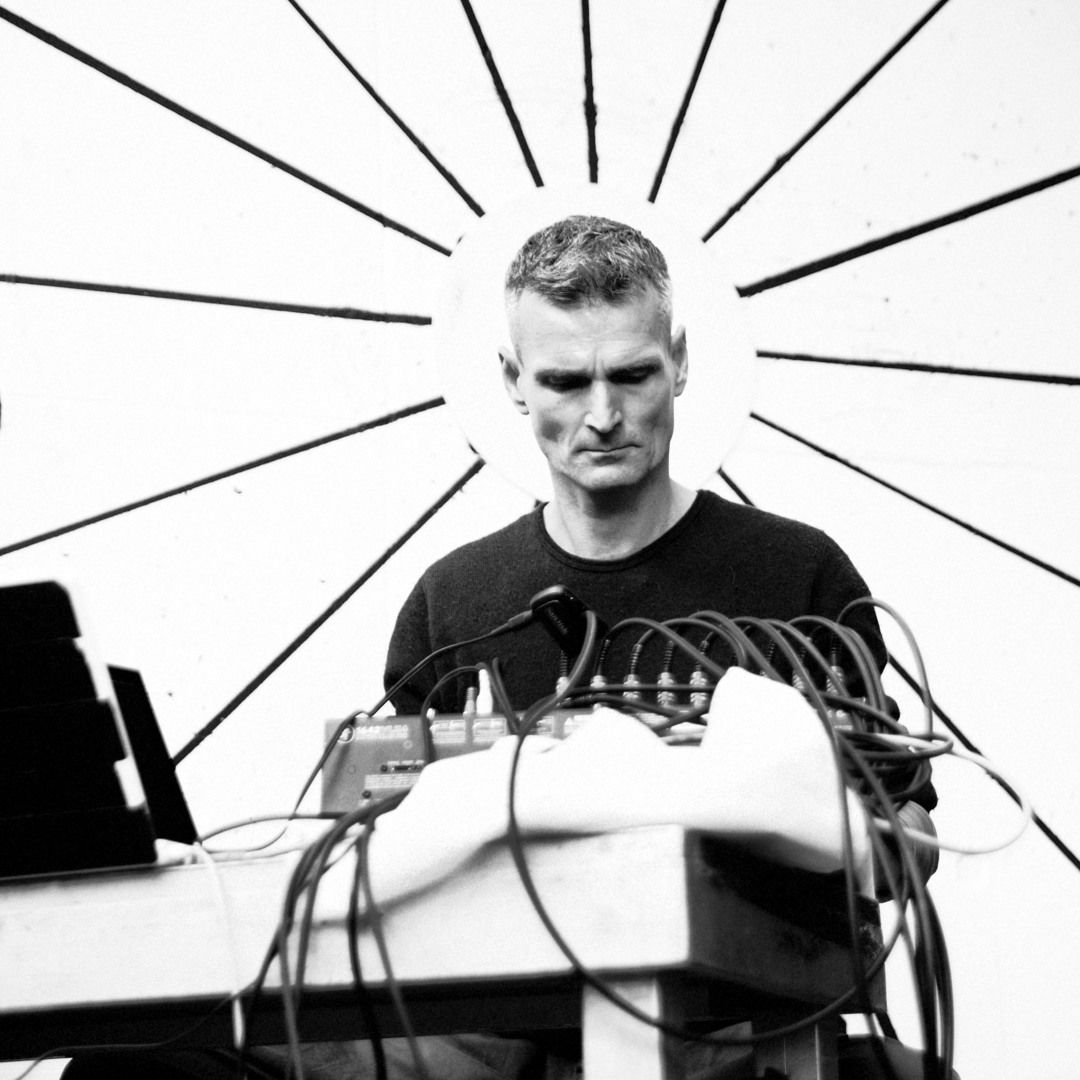
Burnt Friedman – On the Universal Logic of Rhythm
Emerging from Germany's post-punk electronic scene in the 1980s, Burnt Friedman's work has been defined by a restless experimental urge. This impulse led him through the rise of 90s electronica, yet he consistently pushed beyond the confines of any single genre. His search culminated in a pivotal meeting in 2000 with Jaki Liebezeit, the legendary drummer of Can, whose radical rhythmic philosophy sparked an all-consuming new direction.
The principles developed with Liebezeit provided a framework that Friedman would go on to test and expand in diverse contexts, from his work with saxophonist Hayden Chisholm to rhythm-focused dialogues with Persian tombak and daf master Mohammad Reza Mortazavi and Portuguese percussionist João Pais Filipe.
In this conversation, Friedman delves into this philosophy, arguing that true rhythm is based on natural, balanced human motion—a concept captured in Liebezeit's "E.T." motion notation system. He challenges the foundations of Western music theory, critiquing the limitations of standard notation and metronomic grooves. It's a journey into a worldview that sees rhythm as a motion practice.
Alex: Your music has drawn on sounds from far beyond Germany. Was that a conscious decision for you from the very beginning?
Burnt Friedman: After the Second World War, in particular in Germany, groups of musicians would form with the deliberate intention not to be associated with their nationality anymore. Maybe more so than anywhere else in the world because of its history. It was clear that if you create something, you would want to challenge the notion of nationality and tradition because your history had experienced such a horrifying seizure. And those musicians, like Amon Düül, for instance, are still talking about this. Sun Ra would claim that instead of being associated with the Earth, he came from the stars. Outer space has always been the first place to go if you don't want to be associated with your region!
But I can put it more simply. The more you distance yourself from your origin, your nationality, and your culture, the more successful you're going to be in the realm of art. Your findings—your arguments, your message—have to be so interesting that a wider audience is attracted to them. The stronger and more convincing your findings are, in both the arts and science, the more you will be acknowledged for it. It's as simple as that. It’s a reason why German groups in the late '60s are still so relevant today: they were quite deliberate about this.
Alex: You recently re-released a compilation of your music from the 80s. Listening to it, the rhythmic approach feels worlds away from the style you would later become known for. What was the catalyst for that shift in your approach to rhythm?
Burnt Friedman: The influence back then came from TV, radio, and records. Like so many other drummers, I started drumming with no concept, so I just adopted the system that was, and still is, so omnipresent. With the American drum kit—a kit for jazz and rock music—you also adopt a way of drumming and executing rhythm that preempts not only the sound but also the way you move. I was strongly influenced by new wave music back then, hence I started drumming like a rhythm machine, and not much changed until 2000.
Although I was listening to lots of different, mostly programmed music, I wasn't challenging the notion of drumming itself. I had discovered other rhythms, like nines and threes, but they felt like anomalies. I would try to program this intricate stuff on a rhythm machine, but I found they aren't laid out for such a procedure. They are still limited to 16 or 12 steps, much like the Western notation system, and I don't think these conceptualizations will ever change.
However, when I met Jaki Liebezeit in 2000, a lot changed for me mentally. It was really Jaki Liebezeit who first taught me properly about his findings.
Alex: How did you and Jaki first meet, and what was your relationship like at the beginning?
Burnt Friedman: When we first met, I confronted him with a bunch of rhythms that I had laid out on Minidisc players. To be a bit more accurate, I should explain that in the '90s, I had abandoned the drum kit to program rhythm machines instead. My approach was very close to how a real drum kit would be executed. You could call me a naturalist; I programmed the drum machine how I would play them in real life. It fascinated me that you could do supernatural, ultra-precise patterns on these machines.
Because I knew how the rhythm would be executed on a real kit, the level of authenticity was apparent in those programmed grooves. It was almost a simulation of a live drummer, which you can hear on those Flanger records.
Alex: Did you have formal training on the drums?
Burnt Friedman: No, not at all. I learned by copying other drummers, so you could say I learned it the wrong way first.
It reminds me of Jaki Liebezeit's own journey. I found an old video of him from 1957 playing jazz drums in a big band, but he began questioning that style later in his career. After Can disbanded in 1979, he started to develop his own system.
He’d always been a fan of non-Western music—from living in Spain, he’d discovered flamenco and Arabic music—so he knew what was possible beyond the schemes of jazz and rock. He decided to dig deep into the roots of drumming, and his findings were amazing. He completely changed his setup, abandoning foot pedals in the early '90s to play only with sticks. By the time we started creating music, he had already developed his rhythmic system extensively with Drums Off Chaos.
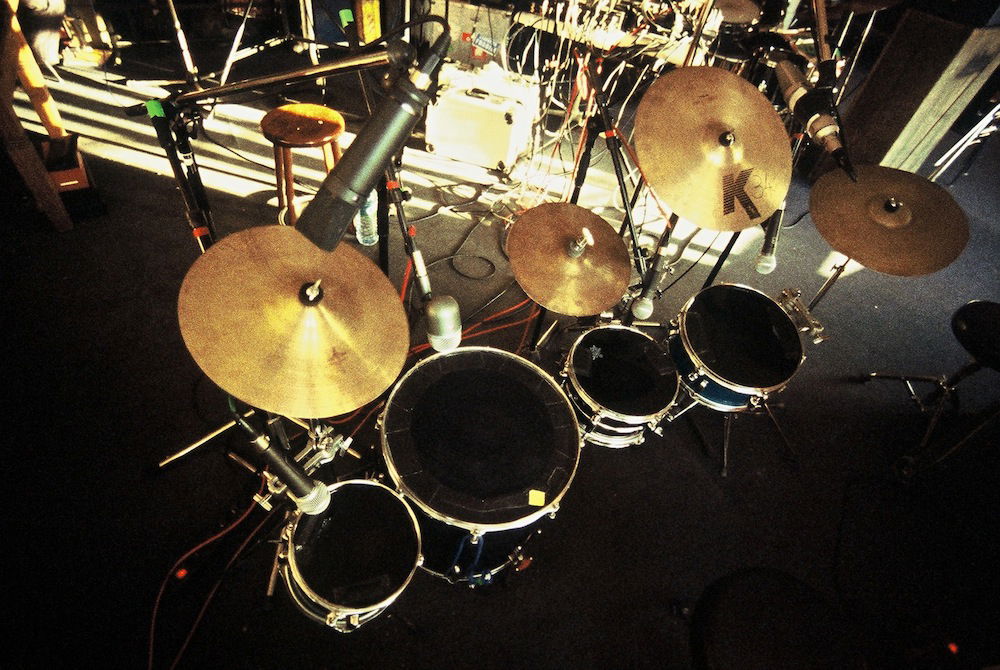
Jaki Liebezeit's drum set up
Alex: The E.T. system? I'm familiar with the notation of dots and dashes, but I have never investigated its rules.
Burnt Friedman: It's an extremely interesting system. I refer to it now even more radically than Jaki would have, because I think I have found the right terms to describe it.
It's a motion notation: it doesn't tell you how things sound; it tells you how you move your left and right hands.
This principle works for any instrument. On a guitar, you play the string up and down. That back-and-forth movement is what I would call swing. You make the same motion in a trill. It's just most obvious with the drums, with the left and right hands. If you imagine balancing a pendulum in your hand, you'd immediately notice that not all movements are possible. For instance, you cannot have two downward strokes without first lifting up. Every downbeat needs an offbeat, otherwise it cannot be properly executed—or it will at least become awkward as the beat gets faster. The system tells you how to execute rhythms effortlessly and stably.
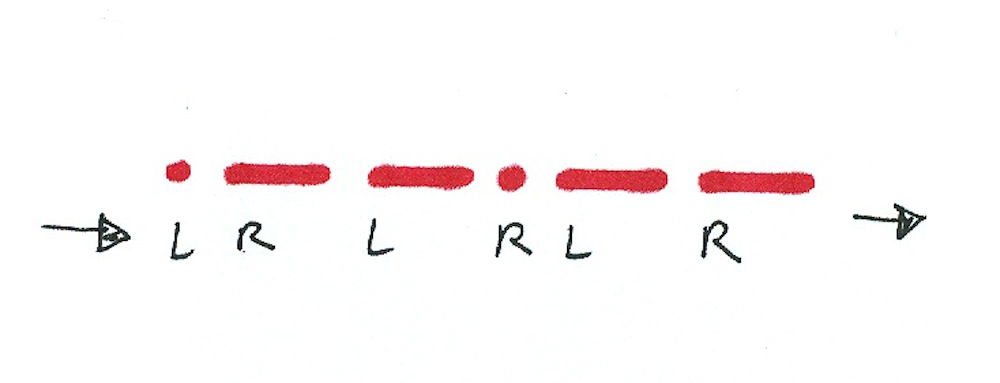
A pattern in 5 with the ET code
Alex: So it's a holistic system, a framework of movement and sound?
Burnt Friedman: Not sound. In fact, you don't need sound for it. That's the interesting part. What we call "rhythm" is just a byproduct of whatever motion we execute. When I decide not to hit something, that pause is also part of the motion pattern. The pause is as important as the stroke you hear.
Alex: So what does this E.T. system do that traditional notation can't?
Burnt Friedman: It tells you how to move, how to execute a motion. While you could notate the same rhythms in a traditional system, the E.T. code accounts for the natural harmony of movement. It introduces you to the fundamentals of moving in a balanced way with your left and right hands.
It tells you how to move, but it doesn't tell you what sound you'll produce. For example, imagine you switched your low tom and your snare drum from one side to the other. The resulting rhythm would be turned upside down, yet your physical motion pattern hasn't changed. The beat changes, but your movement is the same. The E.T. system accounts for the motion, not for the byproduct that we call rhythm.
Alex: And do you still live by this framework in your music today?
Burnt Friedman: Fully, absolutely, because it feels right. Whatever I program, I want to execute and practice it first on a real instrument. These rhythms are like a chord—they have the same ratios and proportions that apply to the fundamental and the fifth, the natural overtones.
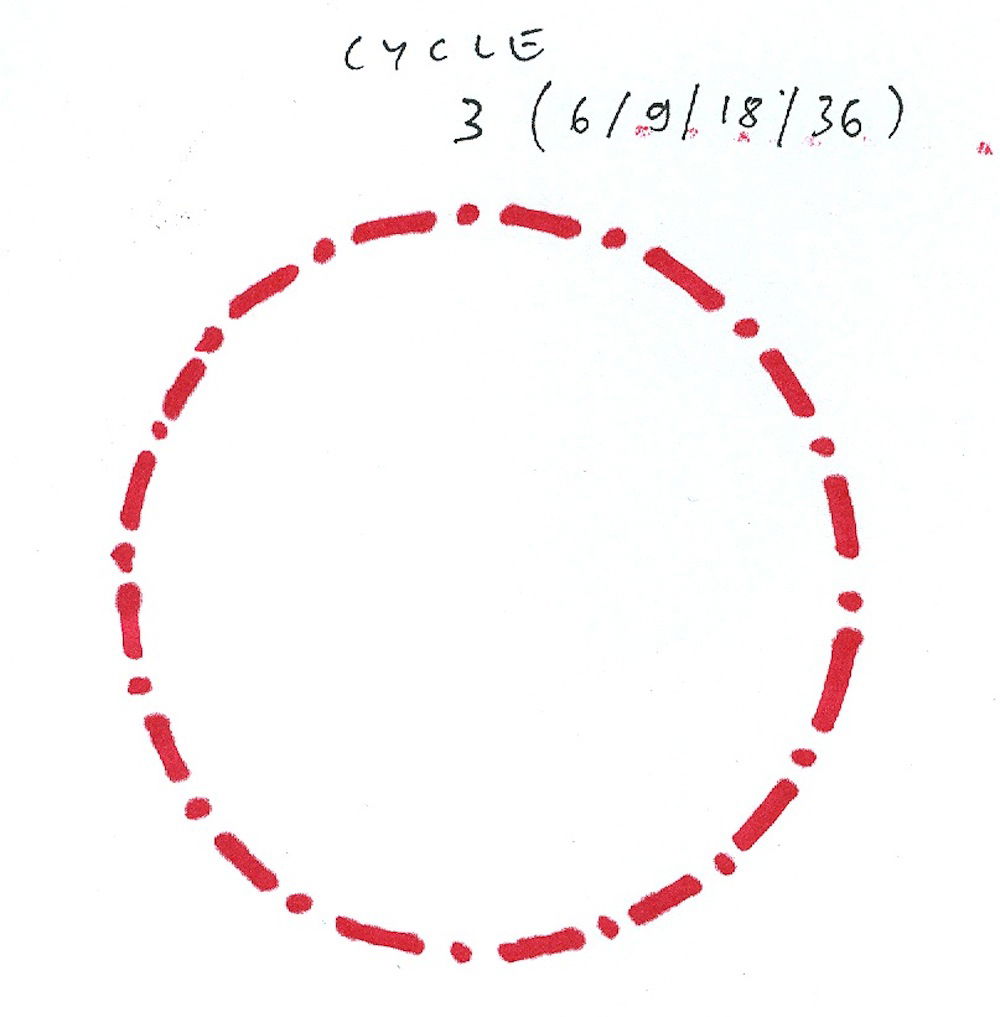
ET code cycle 3
Alex: Are you satisfied that your own music lives up to the ideals of this system?
Burnt Friedman: My opinion doesn't really matter, nor does anyone else's taste. The system operates with what I have to call a universal law, and that law is the octave. A dot and a dash simply account for time intervals: the dot is a value of one, and the dash is a value of two—its octave. It's twice as long. We only operate with this principle. You could call it "filled time". You cannot insert something foreign into it, like a flam, because a flam is not appropriate to the physical motion required.
Alex: Given this system’s radical rules, do you see it as a tool to break free from the conventions of modern music? Is your goal to propose "new" music, or does it serve a different purpose?
Burnt Friedman: I'm not proposing something new. On the contrary, I'm saying there are commonalities in rhythm all over the world. There have always been groups of people playing the same rhythms in the same way, all over the globe, without knowing each other. Back then, it wasn't possible for them to meet, yet they arrived at the same conclusions. This fact alone makes me believe there is common ground in the most fundamental aspect of music: rhythm.
Why is that? When people don't go to school to learn music, they simply practice. They arrive at these conclusions because there is a necessity dictated by the left and right hands to make motion balanced and stable, just as in dance. In order to move your body, you can't jump in an awkward way; you want to dance stably because it's physically demanding. It's the same for drumming. If you beat hard on big drums with heavy sticks, you want to help the groove fly, and this requires basic principles that happen to be the same all over the globe. That's why I'm so confident that Jaki Liebezeit's findings are correct.
If you want to play atonal music, you can do anything you like—a flam here, a flam there, whatever. But that's not what I want. I ask myself, "What does the music want?" It's not about me. I'm trying to understand the music's logic to help the beat fly, to let the music compose itself. I don't want to interfere with some human intricacy or mad idea, but do everything that helps the music function. I'm convinced it will then appeal to other people's minds, though I could be completely wrong.
Alex: You mentioned before that you've considered stopping music, yet you also spoke about being driven by music's own propulsions. What is it about the world today that demotivates you?
Burnt Friedman: For an artist, it's essential to reach an audience. Otherwise, you're just creating for yourself in a loony bin, without a social intention. If I don't have a social intention, then I would not call myself an artist. Whenever I start creating, I want to make a product that conveys a message—something new or interesting about the world that I want to share. That feeling is not very strong anymore, because I'm losing faith in my contemporaries.
Alex: Is that because you think there isn't an audience that understands the music you make?
Burnt Friedman: It's much worse. It seems the music business has completely broken down. I've been told it's in decline ever since I started in the '90s, and things just get worse and worse.
Alex: But music always needs outliers.
Burnt Friedman: Yes, but music today has predominantly turned into another vehicle of self-expression. And with the advent of artificial intelligence, I have to ask what difference I, as a musician, can make in competition with AI. Only once I've figured out what unique difference I can make is it worth releasing anything. If an AI program could have achieved it, why do it? If you can prompt it cleverly and get a satisfying result in 10 seconds, why would you sit down for two weeks?
Alex: It's a very existential question. I mean, why get up in the morning and do anything if it can be automated and programmed? Do you see this as the end of humanity, perhaps?
Burnt Friedman: Yes, humanity is at stake. Absolutely. Not just in terms of music production, but intellectually. People need to ask themselves that question. With the technocratic project we see everywhere, we're witnessing the transformation of a human being into a captured being. And we need to ask ourselves what relation we have to a god. If we are not willing to accept the notion of God, then we might as well be consumed by that new system.
Alex: And do you believe in God?
Burnt Friedman: It's not a question of belief. I have to accept it because it's a thinking necessity. I need to work with the notion of God. I know it's just a word, but it's a necessary term that we operate with daily to figure out things we cannot fathom. We don't have the capacity or perception to penetrate these things, so we created terms to accommodate concepts like the absolute, the beyond, the eternal. They are a part of our daily thinking operations; we need those terms to be functional and to make sense of the world. We have to incorporate the irrational. But to incorporate the irrational is a rational move.
Alex: The idea of needing a framework to make sense of things—even the irrational—is powerful. Does this same philosophy apply to how you see music itself? Do you find the established rules of Western music theory and notation helpful, or are they something you've had to reject to find your own logic?
Burnt Friedman: I’ve never been to a music school, so I haven't learned to read notation. If I had, I might have a different judgment. From my point of view today, it doesn't help me. I don't find it very consistent. I also know that terms like "syncopation" and "offbeat" were derived from that system, and they make it even harder to understand how to groove. For me, the exit route has always been an odd rhythm—a rhythm outside of four.
When I was working in the 4/4 scheme, I actually think I never truly heard a rhythm, because everything was metronomic. It doesn't really groove. My advice is to explore different numbers to understand rhythm. These numbers may appear to be an anomaly for Westerners, but they have always been around and are completely natural to the world of music, even if they are rarely found.
Alex: How do you compose your music? Do you have a physical drum setup that you work with?
Burnt Friedman: Yes. My process now is to drum first and then program it.
My process used to be the reverse. I would start by programming, and I could often do it without even hearing the sounds because I knew instinctively where the steps needed to go. To do this, I used a keyboard with a complex mapping of percussion samples. I had a very specific system: an entire octave of 12 bass drum samples, another octave for 12 snare sounds, another for hi-hats, and so on. The mapping was always consistent, so I could change the sounds within a sequence without reprogramming the rhythm.
The layout of the octave itself had a performance logic. For instance, the C note might be my favorite snare sound, the sharps and flats might be soft notes, and the higher notes would be stranger, more open-sounding snares for creating natural-sounding fills. I don't use that system anymore because the old drives died, but I'm happier for it. Now I work with real drums but have completely abandoned the conventional American rock/jazz kit.
Alex: Finally, I'd like to ask where your creative energy is going now. What's next for you?
Burnt Friedman: I'm sitting on a large archive of video footage that I gathered over the 17 years I worked with Jaki Liebezeit. My idea is to eventually release the best parts of it in a way that conveys this rhythmic system, the philosophy behind it, and the distinction between "West" and "East" in the foreground. I haven't even started to file the videos properly, so it's just the very beginning. I’m grateful for your interest in this subject, as I see an urgency in making this knowledge available to the public. It seems much harder these days to make a point. In the '90s, the times were more conducive to discovering new things, whereas now the consumption of music seems so formatted.
Alex: It sounds like an important project. Thank you so much for being so generous with your time and insights. It's been a fascinating conversation.